
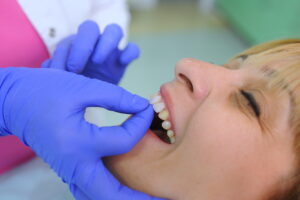
A chipped front tooth. A gray stain whitening never lifts. A gap you have quietly stopped smiling around. At Dental Group Palomar, dental veneers let us correct several of those problems at once instead of chasing them one at a time, and patients throughout Chula Vista, CA come to us for exactly that. Dr. Al plans every case around your existing bite and facial proportions, so the result looks like it belongs to you rather than to a catalog.
Contact UsWhat Are Porcelain Veneers and How Do They Work?
A veneer is a thin shell of dental porcelain, roughly the thickness of a contact lens, bonded to the front surface of a tooth. It resurfaces the part you actually see, so one thin layer can change color, shape, length, and the line of a smile at once. Each shell is made as a custom veneer from a scan of your own teeth, then bonded with a resin cement that cures hard in seconds.
Porcelain reflects light much the way enamel does, so a well-made shell does not read as dental work. Before your consultation it helps to understand the difference between porcelain and composite shells, since the two behave differently over time.
What Problems Can Veneers Fix?
Porcelain veneers solve cosmetic problems in the teeth that show when you smile, usually the front six to ten on top. Patients come to us for:
- Tooth discoloration that whitening cannot reach, including tetracycline staining and the darkening that follows an old root canal
- Chipped tooth repair, worn edges, and hairline fractures from grinding or an accident years ago
- Gaps between teeth too narrow to be worth closing with orthodontics
- Teeth that sit slightly rotated or set back, where the bite is healthy but the smile line is uneven
They do not treat decay, gum disease, or a bite that is out of alignment. Those come first.
Am I a Good Candidate for a Smile Makeover?
You are a strong candidate if your teeth and gums are healthy, there is enough enamel left to bond to, and your concerns are about color, shape, and proportion rather than function. A smile makeover here begins with an exam, x-rays, and photographs, not a sales pitch.
There are situations where we will say no. Heavy grinding fractures porcelain, so clenching gets addressed with a night guard before anything is bonded. Thin or eroded enamel leaves too little surface for a dependable bond. Active gum disease or untreated decay has to be resolved first, because a shell bonded over an unstable foundation will fail. And when crowding is significant, orthodontics gives a better long-term result than masking tooth position behind porcelain. We say so even when it means a longer path.
How Many Visits Does the Process Take?
Most cases run two appointments about two to three weeks apart, with a consultation before either one.
- Consultation: exam, images, and a conversation about shade, length, and how much change you want
- Preparation: a small amount of enamel is removed, the teeth are scanned, the shade is selected, and temporaries go on that you can eat and speak in normally
- Fabrication: a ceramist builds each shell by hand while you wear the temporaries
- Bonding: the shells are tried in, you approve the fit and color in the mirror, then they are bonded and the margins polished
- Follow-up: a short visit a week or two later to confirm the bite feels right
Does Getting Veneers Hurt, and Is Enamel Removed?
The preparation appointment is done with anesthetic and most patients describe it as easier than a filling. A small amount of enamel does come off, generally around half a millimeter, which makes room for the porcelain so the finished tooth is not bulky.
Mild cold sensitivity in temporaries is common and settles once the final shells are bonded. What matters most before you start is that enamel removal is permanent. A prepared tooth will always need something covering it, so decide deliberately rather than quickly.
How Much Do Veneers Cost?
Cost depends on how many teeth you are treating and the material chosen, so we quote it in writing after the exam instead of guessing over the phone.
Dental insurance generally classifies this as cosmetic and does not contribute, though a plan sometimes pays a portion when a shell restores a tooth that is genuinely broken. We check your specific benefits before you commit, and we go through payment options in the same visit so the number is never a surprise. We also align the plan with your budget, which sometimes means phasing treatment.
How Long Do Porcelain Veneers Last?
With sound home care, bonded porcelain commonly lasts ten to fifteen years, and plenty of cases go longer. Failure is usually mechanical rather than a matter of the material wearing out.
What shortens the lifespan is predictable: unmanaged grinding, chewing ice, using teeth to open things, and skipping cleanings long enough for the gumline to recede and expose a margin.
How Do I Care for Them Day to Day?
- Brush twice daily with a non-abrasive fluoride toothpaste, since heavy polishing agents in whitening pastes dull the glaze
- Floss daily, particularly along the gumline where the margin sits
- Wear a night guard if you grind, without exceptions
- Stop using your teeth as tools, and go easy on ice, hard candy, and popcorn kernels
- Keep your cleaning schedule so we can polish margins and catch early wear
- Coffee, tea, and wine will not stain the porcelain but will stain the natural teeth beside it, which is what throws shades out of match
Veneers or Dental Bonding: Which Is Right for You?
Bonding is the better call for a single small chip or one narrow gap when you want it handled in one visit at a lower cost. Veneers are the better call when you are changing several teeth together, masking color that composite resin cannot cover, or you want a surface that holds its polish for a decade.
The trade-off is cost against longevity. Composite is conservative and repairable but picks up stain and needs refreshing every few years. Porcelain costs more up front, requires enamel reduction, and then largely leaves you alone. We walk through both during a cosmetic dentistry consultation so you can weigh them against what you actually want.
Can Veneers Be Replaced or Removed Later?
A veneer can be replaced, but it cannot simply be taken off and left off, because the enamel removed during preparation does not grow back. Plan on the tooth being covered from that point forward.
Replacement itself is straightforward. The old shell is sectioned off, the tooth is cleaned and re-evaluated, and a new one is bonded across the same two appointments as the original. Most replacements follow a chip, a change in the neighboring teeth, or gum recession that exposed an edge, not porcelain wearing out.
Why Choose Dental Group Palomar for Veneers
- Dr. Al completed an advanced residency at the University of Kentucky College of Dentistry with focused training in cosmetic dentistry, oral surgery, implants, and IV sedation
- He maintains dental licensure in two states and holds membership in the American Dental Association and the California Dental Association
- Cosmetic work is planned alongside the full range of dental services we provide, so nothing is bonded over a problem that should have been treated first
- You see options, costs, and expected results before treatment begins, not after
- Prevention, restorative care, orthodontics, implants, and cosmetic treatment come from one team offering coordinated care under one roof
Ready for a Brighter Smile? Book Your Consultation
You do not have to decide on anything today. Come in, let us look, and find out what your options really are. Our office serves families and working professionals throughout Chula Vista, CA, and a consultation is a conversation, not a commitment. Request an appointment through our online form or call us and we will find a time that works. Ready for a brighter smile. Book your appointment today.
Contact Us